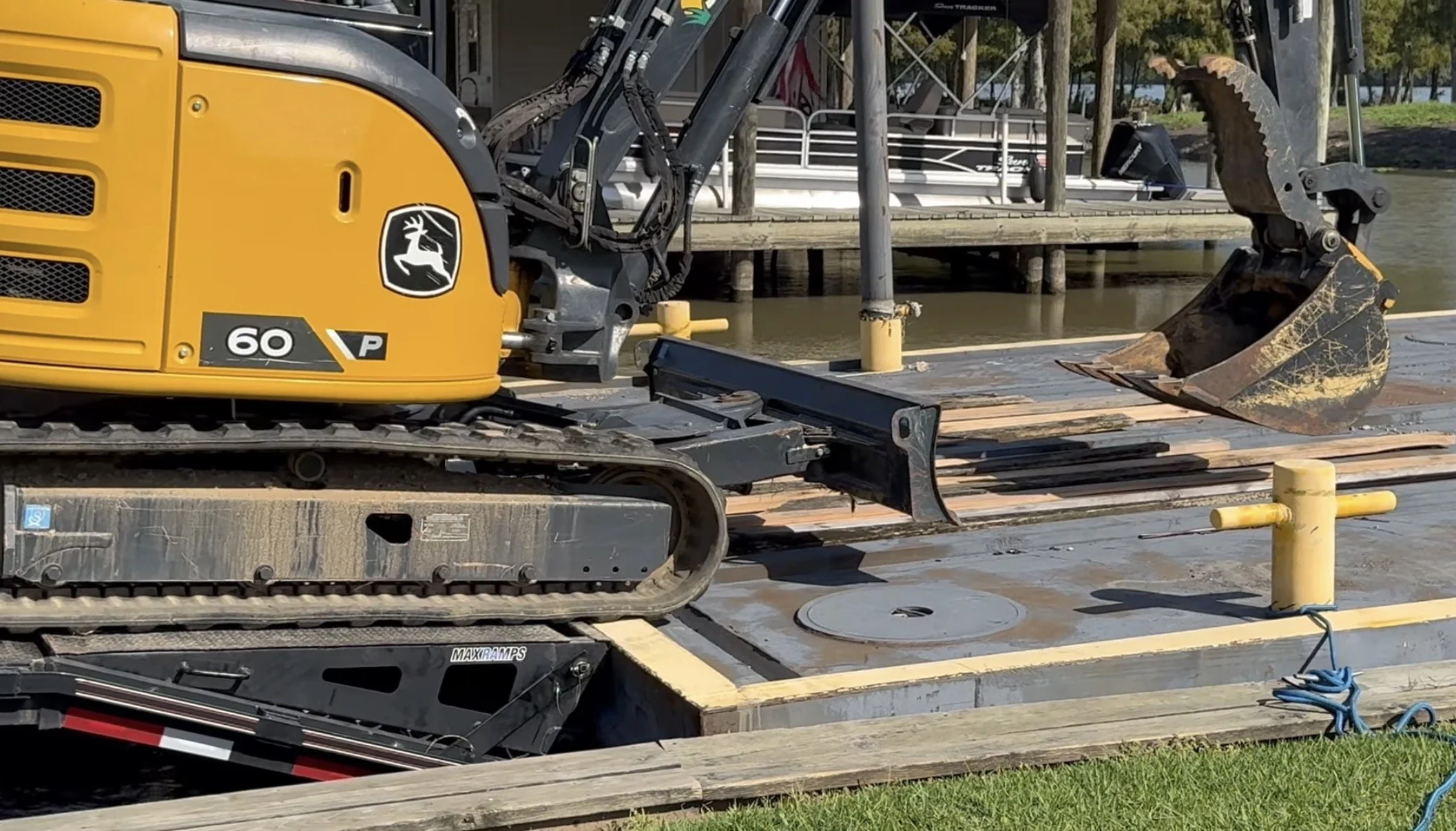
We Put an Excavator on a Barge Last Week. Here's Why…
Most of what we do is dirt work you can drive to. Last week was different.
We loaded our John Deere 60 excavator onto a barge, backed a gooseneck trailer down a boat ramp, pushed the barge out, and hauled concrete out to a small island on Belle River near Pierre Part. The island already had some dirt work done on it, but without something to hold the bank in place, all that work was going to wash right back into the river. So we placed riprap around it — broken concrete stacked along the shoreline to break up wave action and current before it can eat away at the bank.
Couple days of work, and that island isn't going anywhere.
What riprap actually is
Riprap is just rock, broken concrete, or other heavy material placed along a shoreline, bank, or slope to absorb wave and current energy before it reaches the soil underneath. Instead of water hitting bare dirt directly, it hits rock first. The rock doesn't erode the way soil does, so the bank behind it stays put.
It's one of the most straightforward fixes there is for erosion — but it only works if it's placed right. Stack it wrong, leave gaps, or use material that's too light for the current in that spot, and you're just delaying the same problem.
Why this matters if you're on the water in South Louisiana
If your property touches False River, a bayou, a canal, or any other stretch of moving or wind-exposed water, you already know what erosion looks like. A bank that used to be a few feet from the water creeping closer every year. A seawall or bulkhead that's cracking or leaning. Grass that won't hold because the ground underneath it keeps sliding away.
That's not something that fixes itself, and waiting usually means more material, more cost, and more urgency by the time you get to it. Riprap is one of the more affordable ways to get ahead of it, especially compared to a full seawall or bulkhead rebuild.
Why the barge
A lot of waterfront erosion work doesn't have road access — you can't back a dump truck up to a riverbank that's mostly water and cypress trees. That's where the barge comes in. We can load equipment and material onto it, get it right up against the bank or out to an island like this one, and work from the water instead of trying to force a job into a spot that was never built for heavy equipment.
If your situation is "the problem area is basically only reachable by boat," that's not a reason to rule out getting it fixed. It's just a different way of getting the equipment there.
If you're seeing erosion on your property
A few signs it's worth having someone look at:
- The bank is visibly closer to a structure, road, or tree line than it used to be
- You can see undercutting - soil hollowed out beneath grass or root
- A seawall or bulkhead is leaning, cracking, or has gaps at the base
- Storms or boat wake seem to take a noticeable bite out of the bank each time
None of that means you need a massive project. Sometimes it's a stretch of riprap in the right spot. Sometimes it's more involved. Worth having someone take a look before it gets to the point where the fix is bigger than it needed to be.
If you're along False River, Belle River, or any other stretch of South Louisiana waterfront and want to know what it'd take to shore up your bank, reach out. [louisianalandpros.com](https://louisianalandpros.com) or text Maggie at 225-715-9745.